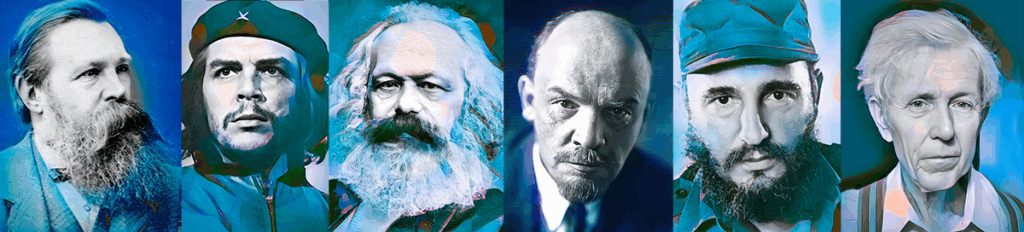
Below you'll find a brief description of each of our 17 papers along with links to online and PDF versions. Ten of these articles are summarized in Socialism Says, but the full papers available here include more quotes, more details, and comprehensive bibliographies. (Printed copies of three papers are also currently being included, along with Socialism Says, in our launch special offer.)
Each paper presents facts related to one or more of the sham, absurd, and dangerous attributes that are key to understanding socialism. Here are links to some of the papers related to each dimension:
Sham
- The "Keto-Friendly" Political Philosophy
- Four Hours Every Weekday
- Karl Marx's "Education of the Future"
- It's Only Socialism If It Doesn't Blow Up
Absurd
- The Secret Sauce of Socialism
- Vladimir Lenin, Ecosocialist?
- Four Hours Every Weekday
- Artist, Visionary, Authoritarian
Dangerous
- The Ripple Effects of Socialist Duty
- Our "So-Called" Rights
- The Socialist Obession: "Parasites"
- Doubling Down on Duty


THE RIPPLE EFFECTS
OF SOCIALIST DUTY
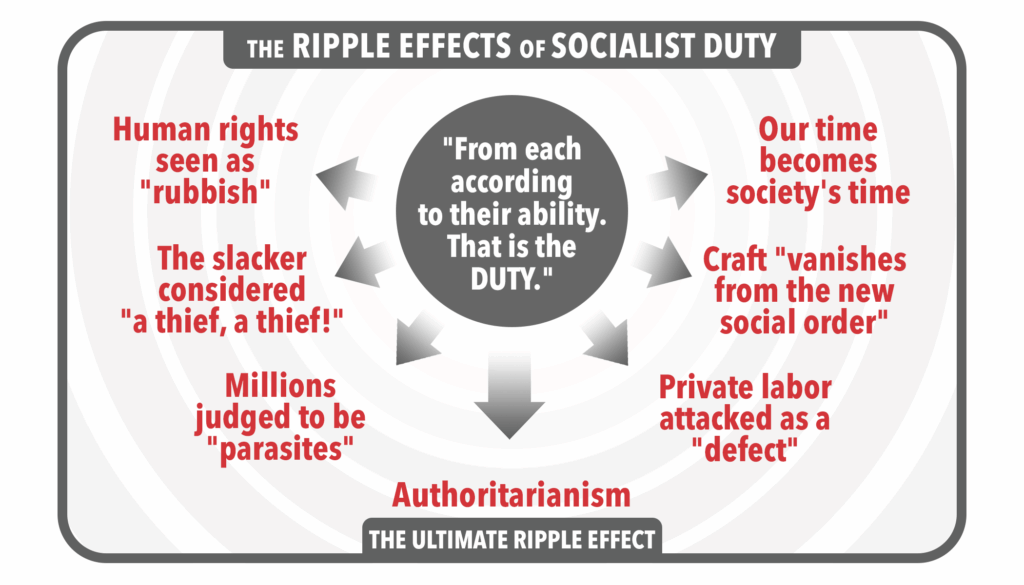
For over 150 years, socialism has been based on the dangerous duty of "from each according to their ability." This anti-liberal compulsory duty has warped socialist philosophy in numerous ways. It has played a key role in causing socialist authoritarianism.
Learn the details in "The Ripple Effects of Socialist Duty" (also summarized in Ch. 2 of Socialism Says).
OUR "SO-CALLED" RIGHTS
For socialism to implement its requirement of compulsory duty to society, it must override our liberal right to use our lives as we choose.
Thus, it's no surprise to discover that socialists have a long history of attacking rights. One critical example: Karl Marx labeled them "rubbish," "nonsense," and "so-called rights."
We study the details in "Our 'So-Called' Rights" (summarized in Ch. 3 of Socialism Says). This paper also compares what socialists say about rights to fascist thinking on this crucial topic. Spoiler alert: it's disturbingly similar.
IT'S ONLY SOCIALISM
IF IT DOESN'T BLOW UP
Today's socialists claim that "socialism has never been tried" and literally argue that the existence of prior socialist societies is a "myth." We review these attempts to deny the socialist past in "It's Only Socialism If It Doesn't Blow Up."
More importantly, this paper explores why socialists resort to these arguments that strain credulity. Why don't they instead explain how socialism has been redesigned to avoid repeating the disasters of the socialist past?
It is because socialism has not been redesigned; its flaws are intrinsic. Contrary to what many have been led to believe, socialists are selling the same product they have long been. Consequently, they are left insisting "socialism has never been tried."
Here are images of a few pages from the PDF version of this paper to give you a sense of what our PDF layouts look like:
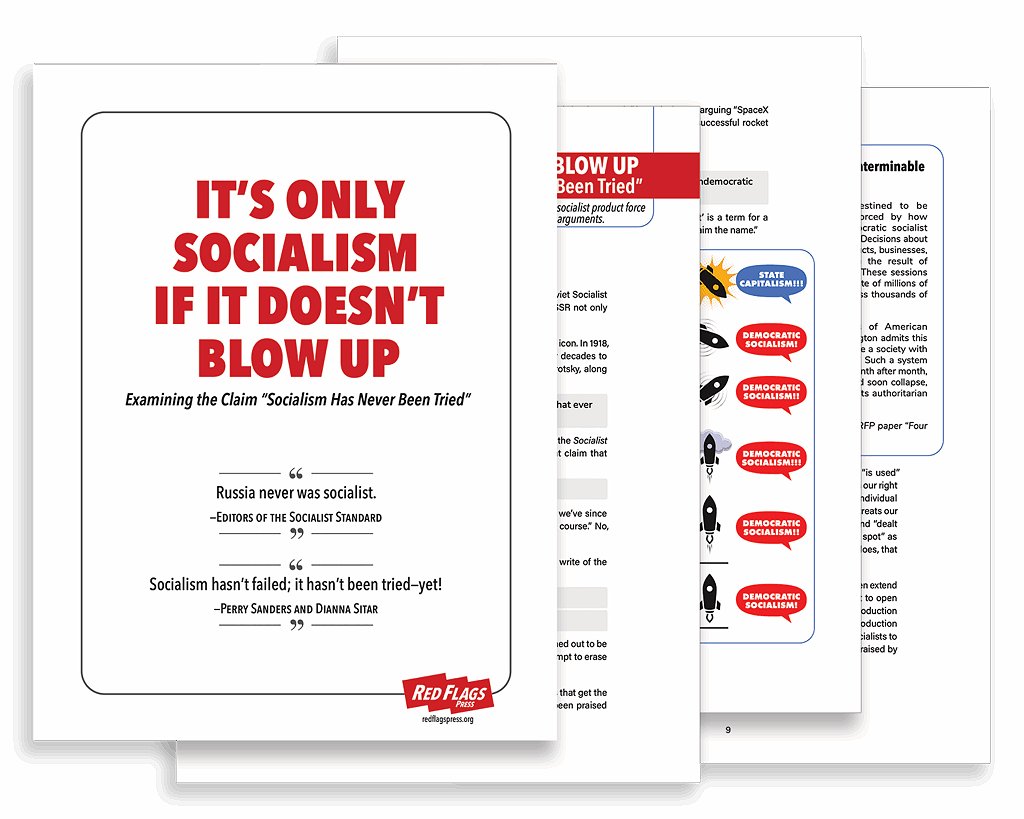
Please note that a printed copy of "It's Only Socialism If It Doesn't Blow Up" is one of three papers we're including, along with Socialism Says and free shipping, in our special launch offer. Details here.
FOUR HOURS
EVERY WEEKDAY
Did you know that socialists admit that their philosophy threatens to create a society of "interminable meetings"? So many meetings, in fact, that a celebrated socialist thinker estimates they would require some 20 hours a week from each of us.
These plans for endless societal meetings are a prime example of the absurd assumptions that underpin socialism. They also put the lie to socialist promises that their philosophy would reduce work hours, thus providing another example of the unethical selling that makes socialism a sham. Learn the details in "Four Hours Every Weekday" (also summarized in Ch. 8 of Socialism Says).
THE SECRET SAUCE
OF SOCIALISM
There's a special ingredient that's essential to cooking up socialism. Socialists say so themselves. It's "superabundance," a.k.a., "limitless abundance"—an overflowing abundance resulting from what Marx termed "constant overproduction."
The assumption that socialism would create a world of overflowing abundance is both absurdly unlikely and ludicrously unsustainable. Yet this premise underpins socialism's most important sales promises, including the claim that socialism would mean a society of "to each according to their need." That ecosocialists still promise a world based on this axiom demonstrates that "eco" socialism is a sham.
Learn about socialism's requirement for a fantasy world of "opulent abundance" and "constant overproduction" in "The Secret Sauce of Socialism" (also summarized in Ch. 10 of Socialism Says).
Please note that a printed copy of "The Secret Sauce" is one of three papers we're including, along with Socialism Says and free shipping, in our special launch offer. Details here.
THE "KETO-FRIENDLY"
POLITICAL PHILOSOPHY
"Democratic" socialism is a misleading marketing slogan, pure and simple. It doesn't represent the new and improved version of the socialist product that the name implies, and so many have been led to believe. No, what today's socialists deceptively label "democratic" socialism is the very same product that socialists have been selling for 150 years: Marxism.
"The 'Keto-Friendly' Political Philosophy" (also summarized in Ch. 7 of Socialism Says) explores seven factors that prove "democratic" socialism is a sham.
THE SOCIALIST OBSESSION:
"PARASITES"
Hundreds of socialist thinkers—including numerous ones said to be democratic socialists—attack those they deem "parasites." And, like Che Guevara, they say socialism looks forward to "drastic measures to eliminate the parasites."
"The Socialist Obsession" (also summarized in Ch. 5 of Socialism Says) explores socialism's fascist-like fixation with alleged "parasites" and their suppression—one of the dangerous byproducts of socialism's foundation on compulsory duty.
We've also developed these additional resources regarding socialism's "parasite" fixation:
101 Damnations Over a hundred additional examples of socialists attacking "parasites," "parasitism," and all things "parasitic."
Learning Democratic Socialism From Eugene Debs Over two dozen examples of democratic socialist icon Eugene Debs attacking "blood-sucking parasites" in a fashion identical to authoritarians.
WHY SOCIALISM SAYS
CRAFTWORK IS "IDIOCY"
Here's a socialist reality that takes most people by surprise: socialism is strongly biased against craftwork and small-scale production more generally.
Socialists admit that "Marx completely rejects the craft ideal," and state that under socialism, craftwork would "vanish," "die out," be "wiped out," etc.
"Why Socialism Says Craftwork Is 'Idiocy'" (also summarized in Ch. 6 of Socialism Says) explores the reasons socialism disdains craftwork—ones that show socialism is not only anti-craft but also fundamentally anti-liberal.
VLADIMIR LENIN,
ECOSOCIALIST?
Today's socialists disingenuously promote tyrant Vladimir Lenin (the first dictator of the USSR) as a proto ecosocialist. They do so despite Lenin's calls for socialism to boost production volumes to levels that are unsustainable in the extreme.
"Vladimir Lenin, Ecosocialist?" (summarized in Ch. 11 of Socialism Says) examines two lessons to be learned from this misleading portrayal of Lenin: First, it's another example of socialist unethical selling. Second, it illustrates the authoritarianism that today's socialists condone.
Please note that a printed copy of "Vladimir Lenin, Ecosocialist?" is one of three papers we're including, along with Socialism Says and free shipping, in our special launch offer. Details here.
DOUBLING DOWN
ON DUTY
Socialism's most famous saying is "from each according to their ability, to each according to their need." But did you know there's a second version of this maxim?
The alternate version imposes socialism's dangerous duty of "to each according to their ability," while cancelling the promise of "to each according to their need." And it's this version that would rule our lives come socialism.
"Doubling Down on Duty" explores this little-known second version of socialism's most famous axiom and its implications.
ARTIST, VISIONARY,
AUTHORITARIAN
Celebrated artist and socialist William Morris envisioned a perfected socialist society, one that today's socialists use to argue that socialism is compatible with liberty.
But as we detail in "Artist, Visionary, Authoritarian," Morris's vision of a socialist future of great liberty rests on farcical assumptions. Moreover, he expected an initial socialist society of suppression to be required to create this fantasy future. The reality is that Morris was a traditional socialist authoritarian, one who—despite being an artist—even called for the suppression of the arts.
WHY SOCIALISM SAYS
SLACKING IS "THEFT"
Dozens of socialist luminaries have labeled slackers as "thieves" and "parasites." Fidel Castro considered laziness one of socialism's "new types of crimes." Vladimir Lenin called for "one out of every ten idlers to be shot on the spot."
"Why Socialism Says Slacking Is 'Theft'" (summarized in Ch. 4 of Socialism Says) examines socialism's attacks on slackers and slacking. It details how these attacks aren't just talk; for example, tens of thousands of alleged slackers were beaten to death in the People's Republic of China.
We've also developed these additional resources regarding socialist attacks on alleged slackers:
Socialists vs. Slackers Over two dozen examples of noted socialists berating slacking and slackers.
Learning Socialism From Fidel Over 30 examples of celebrated socialist Fidel Castro labeling slackers as "thieves" and "parasites."
KARL MARX'S
"EDUCATION OF THE FUTURE"
Marx had a favorite idea, one he wrote about repeatedly over three decades. It was making children labor—child factory labor—an important part of the socialist "school" day.
We explore the details in "Karl Marx's 'Education of the Future'" (also summarized in Ch. 9 of Socialism Says). This paper also examines how today's socialists hide these facts from us as part of their effort to rebrand Marx and socialism—another example of the misleading sales tactics that plague socialism.
DEMOCRATIC SOCIALISM?
DÉJÀ VU ALL OVER AGAIN
Did you know that socialists worldwide claimed the USSR was not only the world's first socialist society but also its first democracy? Or that Cuba was said to be an example of a perfected democracy, despite holding no elections?
"Democratic Socialism? Déjà Vu All Over Again" examines how socialists have long peddled their product as "democratic," claiming that essentially every prior socialist society was democratic socialism in action.
KARL MARX:
"DEMOCRATIC SOCIALIST"
None other than Michael Harrington, the founder of the Democratic Socialists of America, says Karl Marx counts as a "democratic socialist." Harrington repeatedly labels Marx a "democratic socialist" despite Marx calling our rights "nonsense," even though Marx considered himself a "communist," etc., etc.
"Karl Marx: 'Democratic Socialist'" reviews the times Harrington calls Marx a democratic socialist and the implications thereof.
A "DEFECT" OF LIBERALISM
Today's socialists say our "private labor" rights—our right to choose work individually without government interference—are a "defect" of our liberal society. They say that our private labor rights must be replaced by what Marx termed "directly social labor," that is, our work under society's control, not our private control.
"A 'Defect' of Liberalism" explores this dangerous byproduct of socialism's foundation on compulsory duty.
SOCIALISM? COMMUNISM?
WHAT'S THE DIFFERENCE?
How have socialists utilized the terms "socialism" and "communism" from Marx's time to the present day? We review the details in "Socialism? Communism? What's the Difference?"
This paper also explores how socialists' choice of what to call themselves is motivated by marketing considerations—an ironic reality given socialists' long-running claims to disdain sales and marketing.



Please subscribe to email updates and follow us on social media.